As visionary artist Carlito Dalceggio unveils a monumental new work at Sabina Ibiza, Maya Boyd explores the deep reverence for art and its makers that lies at the heart of the estate’s aesthetic and spiritual philosophy.
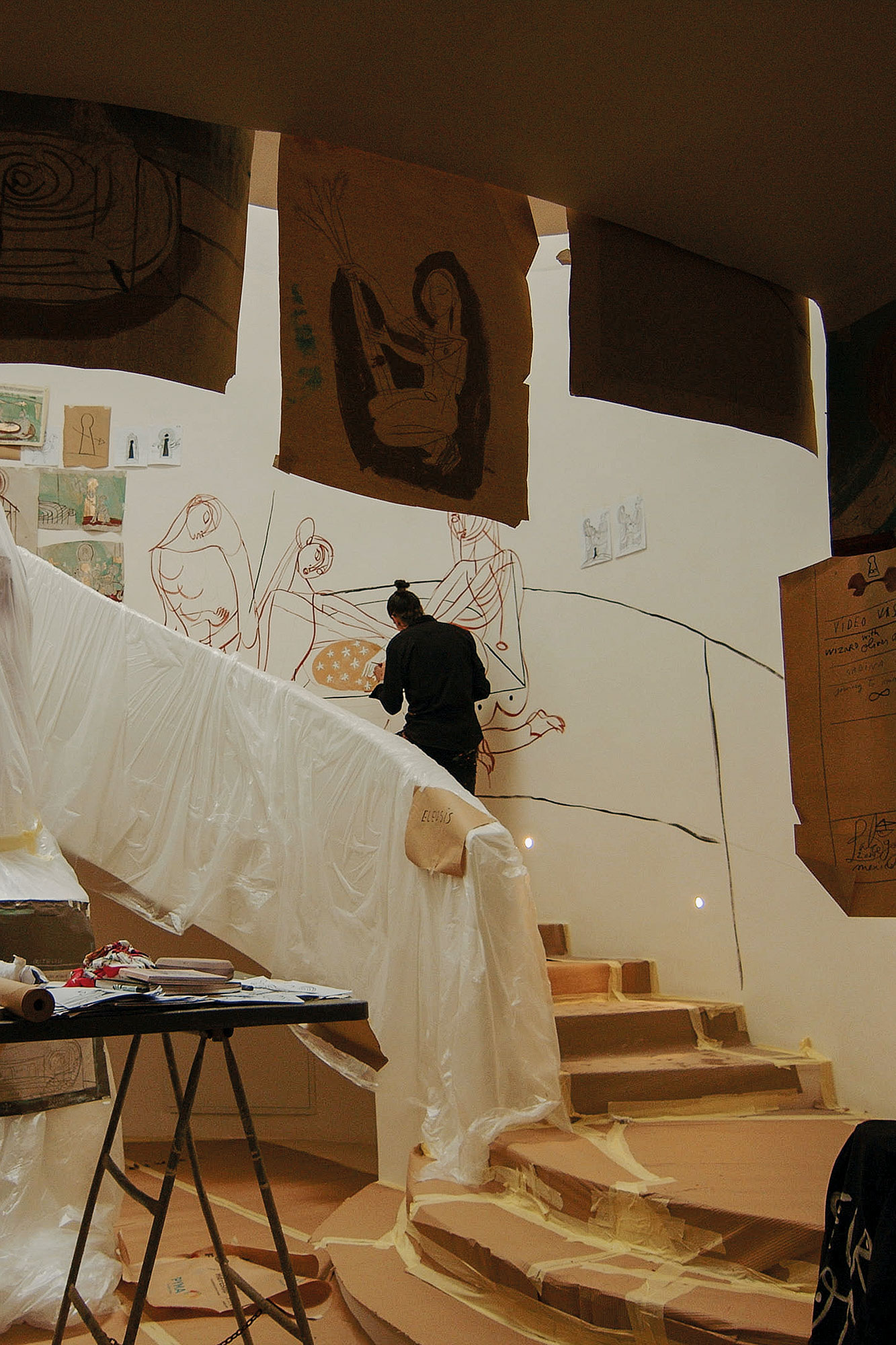
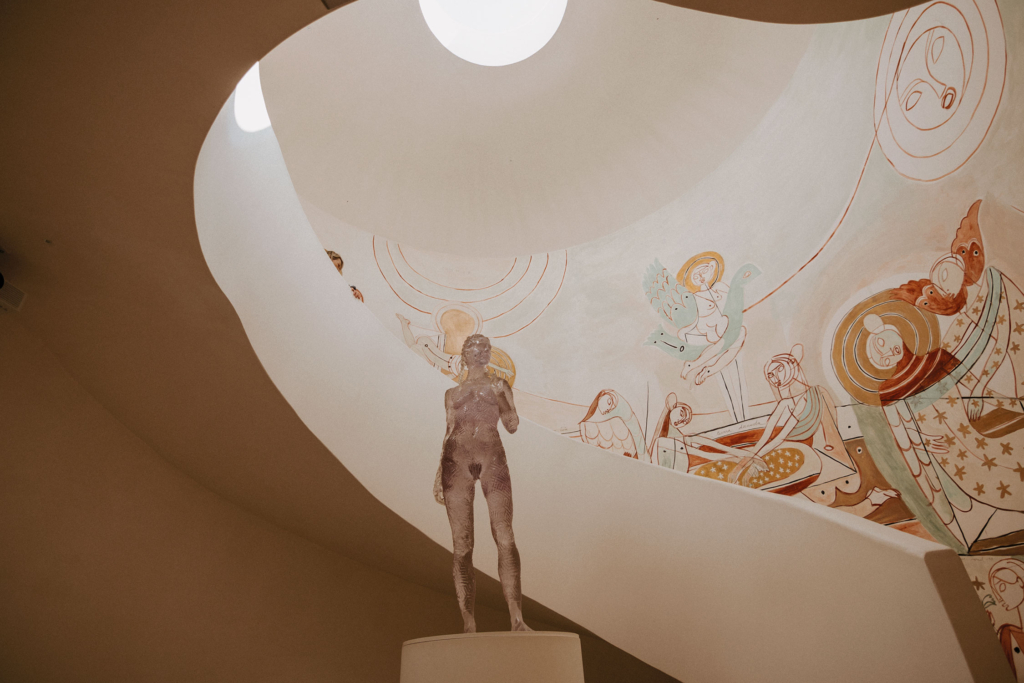
By the time the sun slips behind the cliffs of Cala Tarida and the air softens to amber, there is a stillness at Sabina Ibiza that feels almost sacred. It is here, on a winding white staircase at the heart of the estate’s Clubhouse, that a new mural has emerged—a vast, mythic portal that shimmers with symbolism and talismanic energy. Unveiled last month, The Road to Eleusis was created by nomadic artist Carlito Dalceggio in conjunction with cult New York-based light mapper Oliver Allaux. The monumental work draws from the Eleusian Mysteries of Ancient Greece—those secret rites of passage held in honour of goddesses Demeter and Persephone. The piece speaks to the cyclical nature of life, of light and dark, of descent and return, of transformation through the sound of silence. Swirls of celadon and gold envelop archetypal figures: the seeker, the priestess, the seed awaiting spring, the initiate on his journey to psychedelic transcendence. The mural, Dalceggio muses, is not an image but a mirror— ‘a place for people to meet themselves.’ Dalceggio artist paints not for the eye, but for the soul, seeking to transcend the metaphysical cages imposed by both society and the mind. ‘I don’t believe in frontiers,’ he says. ‘I am a child of the cosmos. I believe that peace will return to earth when the only frontiers we know are those of the soul.’

The American essayist Anaïs Nin once wrote that, ‘Art is the method of levitation, in order to separate oneself from enslavement by the earth.’ This perhaps is the essence of Sabina: not just a place to dwell, but to awaken. Founded with the belief that art speaks not just to decoration but to devotion, Sabina is Ibiza’s first purpose-designed private villa estate, and a bold experiment in community and consciousness, designed by a rollcall of the planet’s finest architects – including John Pawson, David Chipperfield and Ibiza’s own Rolf Blakstad. For co-founder Anton Bilton, the intention was to recreate ‘that overwhelming presence of the Other; some sort of awakened remembering to a Platonic ideal; a forgotten dream; a truth; a place we`ve come from and will one day return.’ Under the curation of art consultant Elizabeth Smith of Ibiza-based SmithVaitiare, the estate’s collection has evolved into something more akin to a living temple than a typical display. ‘We wanted each piece to feel like an offering,’ Smith says, “Not just beautiful, but meaningful. Each piece was chosen to represent an element of spirit, artworks that hold space, that invite people to feel and reflect and remember who they are beyond the noise.’
The art here is indeed intentional. In the serene hush of the Clubhouse, Chilean artist Catalina Swinburn’s Ritual Shroud is a sculpted cape crafted from thousands of tiny origami folds torn from a dismantled first edition of Paramahansa Yogananda’s acclaimed spiritual classic, Autobiography of a Yogi. At the far end of the Clubhouse pool, a three-metre-high bronze Buddha by British-born Sukhi Barber is composed of 1000 interlocking meditators. The spa and temple are adorned with the work of Joaquin Vila, a Spanish artist whose otherworldly paintings represent the union of nature through hybrid beings composed of humans, plants and animals. Every piece, it appears, is chosen to raise more questions than it answers. ‘The first thing we ask of each work,’ Smith explains, ‘is: how does this shift the space it inhabits? How does it shift the people in it?’
It is in the Clubhouse—the social and spiritual heart of the estate—where the collection reveals its full intent. This is not a gallery, nor a showroom. It is a gathering ground for ideas, for the unsaid and the ineffable, where art is the unspoken language. The intention, says Smith, is not to impress but to evoke. ‘We’re interested in consciousness. In how art can be a kind of ceremony. A practice of remembering.’ This ethos echoes the ancient principle at the heart of indigenous cultures worldwide: that art is not something separate from life, but a way of seeing it more clearly. At Sabina, this belief runs deep. The architecture draws from sacred geometry; the gardens are planted according to lunar cycles; the community rituals—from solstice dinners to silent walks—are framed as living art.
There is, undeniably, beauty here: in the salt-silvered olive trees, in the whisper of sea lavender on the breeze, in the slow ritual of light moving through Dalceggio’s living mural. But Sabina’s true allure lies beneath the surface, in the invisible architecture of intention. It is a place built not just of limestone and wood, but of story and symbol and soul.
As dusk deepens and the mural glows in hues of otherworldly blue, Allaux’s light dances across the curved wall, illuminating golden stars, unfurling wings and women ascending from the shadows. And it is here, in this silent alchemy of paint and illumination, that the truth reveals itself: this is not merely art upon walls. This is art as a threshold, art as an invocation. Art as a sacred rite of remembrance—calling us back to the ancient knowing within.

For House Sales and Seasonal Rentals please contact: sabina@sabina-estates.com